Nylon 3D printing: what it is and when it's worth it

Nylon is the everyday name for polyamides, or PA, and in 3D printing it's the material people reach for when a part has to flex, take a knock or keep rubbing against something without wearing out. That toughness comes at a price: nylon soaks up water from the air, prints hotter than many home printers are set up for and warps easily. For most downloaded models, PLA or PETG does the job, so nylon is worth the effort only when a part really needs what nylon does well.
What nylon is, and the types you'll see on a spool
Nylon isn't one material but a family of polyamides with slightly different chemistry, and the label on the spool tells you which one you're getting:
- PA6 (nylon 6): tough and strong, but it absorbs moisture quickly and warps readily without a heated bed and an enclosure.
- PA66 (nylon 6/6): close to PA6, with a slightly higher melting point and more stiffness and heat resistance. Just as thirsty and just as prone to warping.
- Copolymers (often sold as CoPA or PA6/66): made from the building blocks of both PA6 and PA66, and sold as general-purpose nylons.
- PA12 (nylon 12): absorbs less water than PA6, so it holds its size better, and it's more flexible and usually easier to print.
- PA612 (nylon 6/12): in between - it absorbs less water than PA6, is stiffer than PA12 and warps less than PA6 or PA66.
- PA11 (nylon 11): similar to PA12 but made from castor oil rather than petroleum, and less common as filament.
- Carbon fiber and glass fiber blends (PA-CF, PA-GF): the fibers make nylon stiffer and more dimensionally stable and cut warping, but they wear out brass nozzles.
- High-temperature nylons (PAHT, PPA): PAHT is a label for high-temperature blends rather than one nylon, and brands build it on different types, from PA12 to PPA. PPA (polyphthalamide) handles more heat and absorbs less water than PA6. Both usually come fiber-filled and need a hotter nozzle, often 280°C or more.
| Type | Moisture uptake | Ease of printing | Stiffness | Typical use |
|---|---|---|---|---|
| PA6 | High | Hard | Moderate | Tough functional parts |
| PA66 | High | Hard | Higher | Parts that see more heat |
| Copolymer (CoPA) | High | Moderate | Moderate | General-purpose nylon |
| PA12 | Lower | Easier | Lower, more flexible | Parts that must hold their size better than other nylons |
| PA612 | Lower than PA6 | Easier than PA6 | Between PA6 and PA12 | General functional parts |
| PA-CF and PA-GF | High (the nylon still absorbs) | Easier, less warping | High | Stiff brackets and fixtures |
Relative ratings; actual properties vary by formulation, settings and geometry.
When nylon is worth it (and when it isn't)
Nylon earns its keep on parts that work for a living:
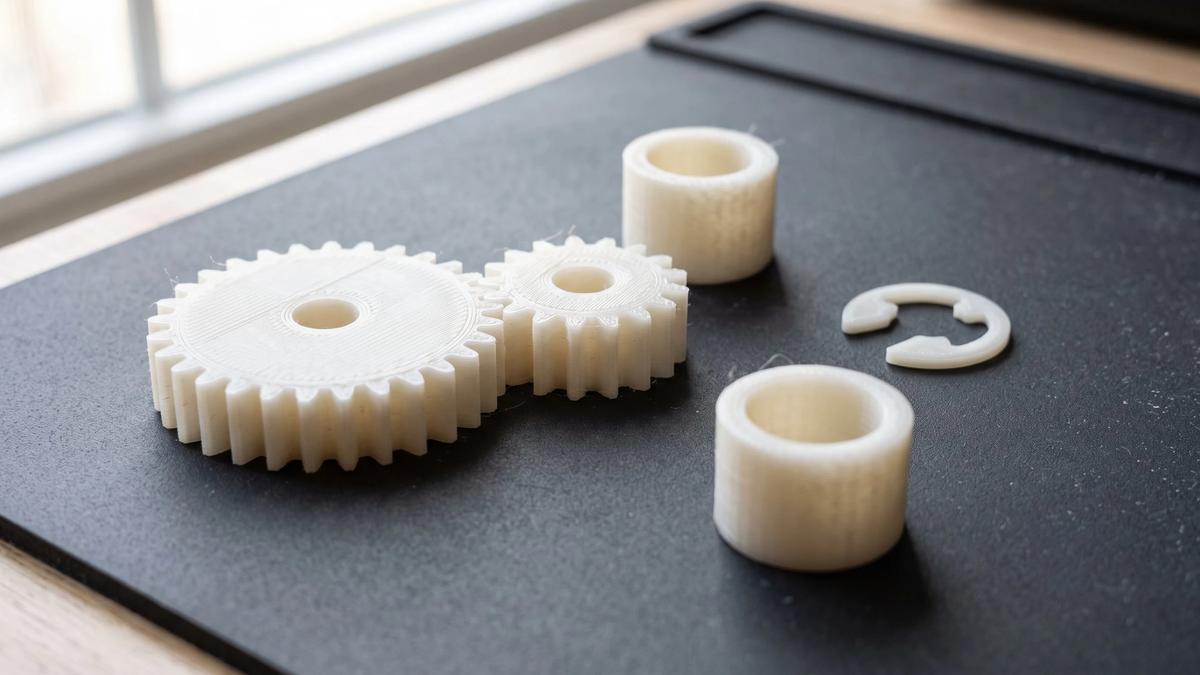
- Parts that rub or slide, such as gears, bushings and guides. Nylon has low friction and resists wear.
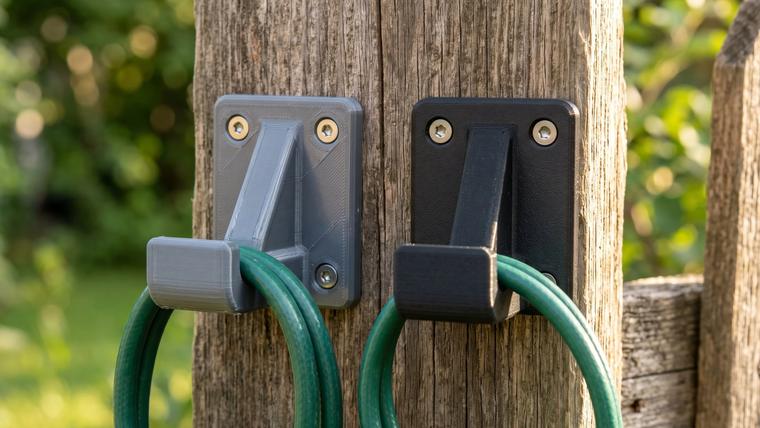
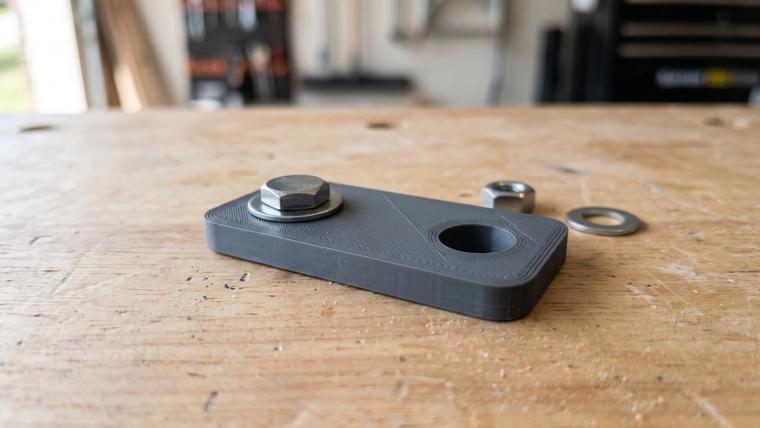
- Parts that flex or get knocked, such as clips, snap-fits and brackets. Where PLA would crack, nylon bends and recovers.
- Tools and fixtures that get handled roughly, from jigs to holders.
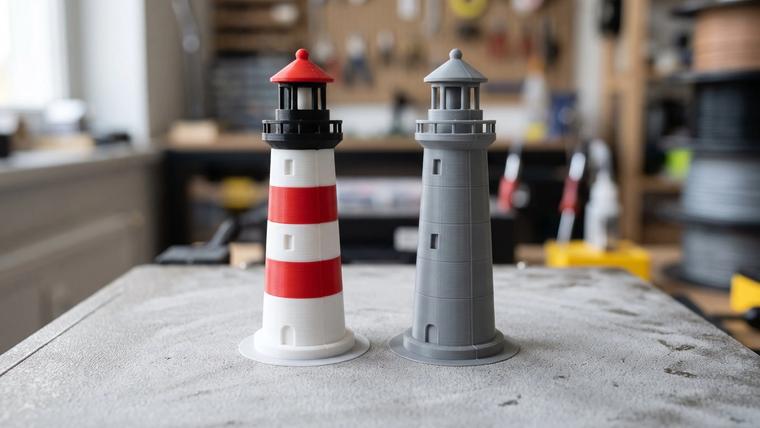
It's the wrong choice for display models, figurines and miniatures, where PLA prints sharper details with far less effort. It's also a poor fit for rigid parts that must keep exact dimensions as the humidity changes, because nylon swells slightly as it absorbs water. And for many everyday functional parts, PETG is tough enough and much easier to print. Our guide to choosing filament puts nylon alongside the everyday materials.
Nylon also creeps: under a constant load, such as a bolted bracket, it slowly gives way. In CNC Kitchen's bolt tests, screws through carbon fiber PA6 that hadn't been annealed needed re-tightening almost every day for a week, while PA12 and annealed PA6 held about as well as PLA.
Water: nylon's biggest catch
Nylon is hygroscopic: it pulls water out of the air. Prusa warns that badly stored nylon can take up water weighing as much as 10% of the filament, and Bambu Lab's drying guide says that freshly dried filament in a typical room starts picking up moisture again within hours.
Wet nylon prints badly. The water turns to steam in the hot nozzle, so you hear popping and get bubbles, stringing, a rough surface and weak layers.
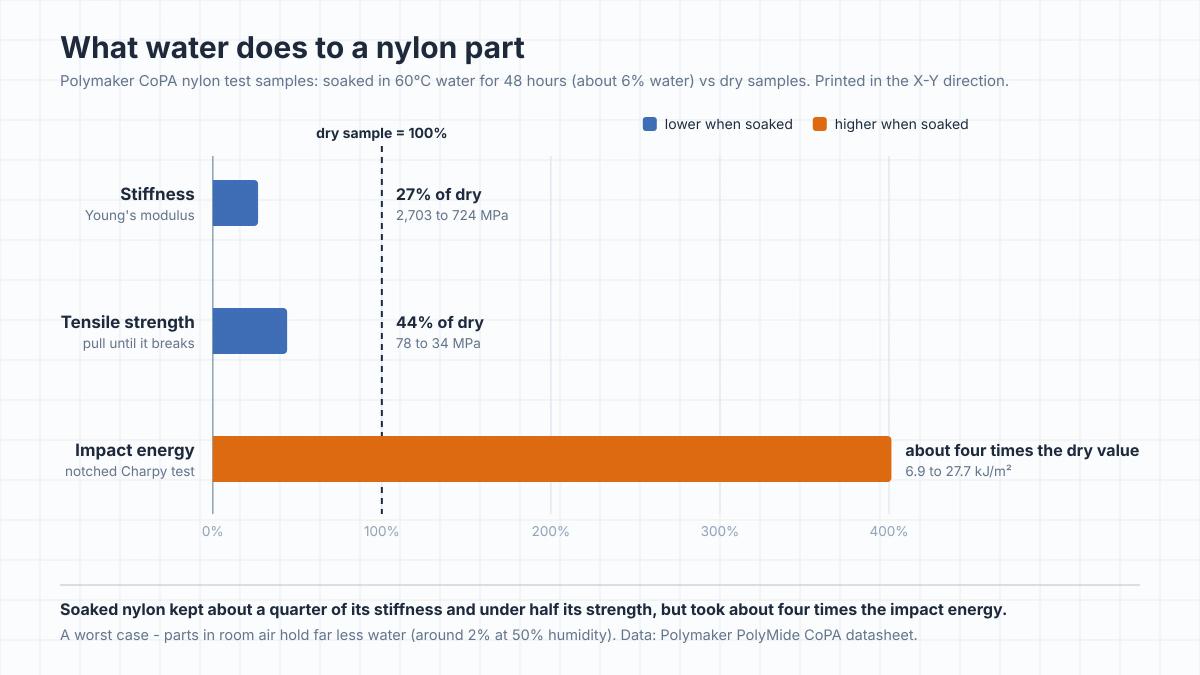
The water keeps working after the print, too. A nylon part absorbs moisture from the air for as long as it exists, and the water acts as a plasticizer: the part gets softer and more flexible, but tougher. In Polymaker's datasheet for its CoPA nylon, samples soaked in 60°C water for 48 hours, which left them holding about 6% water, kept only about a quarter of their stiffness and less than half of their tensile strength, but absorbed about four times as much energy in an impact test. That's a worst case, since a part in ordinary room air holds far less water, but it shows which way things move. At room temperature and 50% humidity, nylon settles at around 2% moisture and grows by about half a percent in size, according to plastics supplier W. S. Hampshire.
So dry nylon before you print it whenever it has been sitting out. Makers' advice varies: Bambu Lab lists 75-85°C for 8-12 hours in a drying oven for nylon and its fiber blends, Prusa says at least 4 hours below 90°C, and UltiMaker dries its nylon overnight, for 10-20 hours. Start from your spool's label, and don't go hotter than the spool itself can take. Use a filament dryer or a drying oven rather than a kitchen oven, where spots near the heating elements get hot enough to damage the spool and the filament. Spools left in open air for months are hard to rescue: Bambu Lab says nylon that has sat out for about three months absorbs moisture so deeply that a normal drying run struggles to get it out.
Keep the filament dry while it prints as well. Feed it from a dry box or a sealed container with desiccant, so it doesn't pick up water during long prints, and store spools airtight in between. Bambu Lab says most filaments need storage below 20% relative humidity to stay dry for long, and suggests checking with a hygrometer rather than guessing.
What your printer needs for nylon
Nylon asks more of a printer than PLA or PETG does. Before you buy a spool, check that yours has:
- An all-metal hotend. Many nylons print at 250°C or more, and hotends with a PTFE liner that reaches into the hot zone are usually limited to about 240°C.
- Enough heat at the nozzle and the bed. Most nylons print between about 230°C and 290°C at the nozzle, and some high-temperature grades go higher still. Bed temperatures vary widely, and some nylons ask for 100-110°C.
- An enclosure. Warm, still air around the print is the main defense against warping and splitting layers. Prusa says one "helps a lot", and carbon fiber nylons warp much less - Prusa says they can be printed without an enclosure.
- A plate that holds nylon. Textured PEI with a thin layer of glue is a common starting point; some makers suggest a PC plate or an adhesive made for nylon, and Prusa recommends a dedicated nylon sheet. Garolite (G10) sheets are a long-standing alternative: in Maker's Muse's tests, nylon held well on a heated G10 sheet and often released by itself as it cooled.
- The right nozzle. Carbon fiber and glass fiber nylon wears brass nozzles out quickly, so it needs hardened steel or another wear-resistant nozzle, and Bambu Lab recommends 0.6 mm as the first choice for its carbon fiber nylons. Polymaker recommends a wear-resistant nozzle even for its unfilled CoPA.
- A feed path for fiber-filled spools. Stiff, brittle fiber-filled strands can snap or wear the tubes of a multi-material feeder: Bambu Lab advises against third-party fiber-filled filaments in its AMS, so check your feeder's guidance or feed these spools from a dry box.
- Ventilation. Prusa says nylon must be printed in a well-ventilated room or an enclosure, because of its strong smell and the ultrafine particles it gives off.
Unfilled nylon has one handy side use: Prusa notes it works for cold pulls, the cleaning trick our nozzle cleaning guide uses to pull debris out of a partly clogged nozzle.
Print settings that matter
There's no single set of nylon settings, because brands differ more than you'd expect:
| Setting | Typical starting range | Notes |
|---|---|---|
| Nozzle temperature | About 230-290°C | Polymaker gives 250-270°C for its CoPA, UltiMaker 230-260°C for its nylon and Prusa 285°C; fiber-filled grades often run at 280°C or more |
| Bed temperature | About 25-110°C | Polymaker gives 25-50°C, UltiMaker 40-70°C and Prusa 110°C |
| Part cooling fan | Off or very low | Cooling makes warping and layer splitting worse |
| Print speed | Varies widely | Polymaker gives 50-200 mm/s for its CoPA, while Bambu Lab suggests about 100 mm/s at most for its carbon fiber nylon |
| Brim | Usually | Gives the corners more to hold on to |
| Infill | 50% or less | From Bambu Lab's tips for its nylon blends: lower the infill if a part warps, and stay at or below 50% |
Typical ranges from manufacturers' guides; start from your filament's profile or the label on the spool.
By type, Polymaker gives about 250-270°C for PA6 and 240-260°C for PA12 at the nozzle, and PA66 usually wants a hotter bed, around 80-100°C.
For structural parts, Bambu Lab suggests five walls with about 25% infill rather than a dense fill.
With the fan off or very low, overhangs and bridges droop more than in PLA, so orient parts to keep them short.
Warping and bed adhesion
Nylon is one of the worst common filaments for warping: Creality rates its risk as very high, above ABS. The fixes are the same as for any material that warps - a warm enclosure, no drafts, a brim and a clean plate with the right glue - and our bed adhesion guide covers them in detail. If your enclosure has no heater of its own, let the heated bed warm the air inside for 15-20 minutes before the print starts.
Two tips are specific to nylon. Prusa's support team suggests printing the skirt a few layers taller than usual, which helps against warping. And Bambu Lab suggests infill patterns with fewer long straight lines.
After the print
- Remove supports soon. Bambu Lab advises removing supports from its nylon blends within two hours, before the material absorbs moisture and softens. Polymaker warns that nylon printed as its own support can bond to the part permanently once it has taken up water.
- Anneal if the datasheet allows it, especially PA6. A slow bake makes some nylons stronger and, in PA6, sharply cuts creep: in the same CNC Kitchen tests, annealed PA6 crept about as little as other common plastics, and annealing changed the parts' shape by less than 0.5%. Times and temperatures differ by brand: Polymaker anneals its CoPA at 80°C for 6 hours, while Bambu Lab gives 120-130°C for 5-8 hours for its carbon fiber nylons and reports gains of about 10-20%, but warns that some parts shrink and warp in the process.
- Expect the part to change. A freshly printed part is at its driest, so it's stiffer but less tough than it will be once it has taken up moisture from the air. Bambu Lab notes that a waterproof coating can slow this down. If a part needs its full toughness right away, you can condition it on purpose in a humid container or a water bath, the same way industrial PA6 parts are conditioned.
Nylon without a filament printer: SLS and MJF
Search for nylon 3D printing and much of what comes up is industrial: services that print nylon parts by selective laser sintering (SLS) or Multi Jet Fusion (MJF). Those machines don't use filament. They fuse thin layers of nylon powder, usually PA12 or PA11, and the loose powder supports the part as it prints, so there are no support structures to remove.
If you need a handful of tough nylon parts and your printer can't handle nylon, ordering them from a service can make more sense than upgrading your printer. Our FDM explainer covers how filament printing works by comparison.
Frequently asked questions
Is nylon stronger than PLA?
It's tougher rather than simply stronger. PLA is stiffer, but it's brittle and snaps; nylon bends, absorbs impacts and resists wear. How a nylon part behaves also depends on how much moisture it holds, because water makes it more flexible and less stiff.What temperature do you print nylon at?
Most nylon filaments print at roughly 230-290°C at the nozzle, and bed temperatures run from about 25°C to 110°C depending on the brand. Start from the settings on the spool or the maker's profile, because they differ a lot between brands.Do you need an enclosure to print nylon?
It's strongly recommended for most unfilled nylons. Nylon warps strongly, and an enclosure keeps the air around the print warm and still. Carbon fiber nylons warp much less, and some can be printed without an enclosure.Do you need a hardened nozzle for nylon?
For carbon fiber or glass fiber nylon, yes, because the fibers wear out a brass nozzle quickly. Unfilled nylon is far less abrasive, though some makers still recommend a wear-resistant nozzle for it.Why is my nylon print bubbly or stringy?
The filament is most likely wet. Water in nylon turns to steam in the hot nozzle, which causes popping, bubbles, stringing, a rough surface and weak layers. Dry the spool as its maker recommends and feed it from a dry box.What's the difference between PA6 and PA12?
PA6 is tough and strong but absorbs moisture quickly and warps easily. PA12 absorbs less water, so it holds its size better, and it's more flexible and usually easier to print. In CNC Kitchen's tests of the carbon fiber versions, dry PA6 was stronger, stiffer and more heat-resistant, but after absorbing moisture it kept only about a third of its stiffness, while PA12 barely changed. PA12 is also one of the main nylons used by powder-based printing services.How long should you dry nylon filament?
Anywhere from at least 4 hours to overnight, usually at around 75-90°C, depending on the brand. Follow the temperature on your spool's label, don't exceed what the spool can take, and use a filament dryer or drying oven rather than a kitchen oven.Can you print nylon on a PEI plate?
Yes, usually with a thin layer of glue. Textured PEI with glue is a common choice, and some makers suggest other surfaces, such as a PC plate or a dedicated nylon sheet, so check your filament's instructions.
About the author
Written by
Ethan MillerI’m a 3D printing specialist with a background in mechanical design and hands-on experience with FDM 3D printing. I focus on filament selection, slicer settings, print optimization, and troubleshooting common printing issues. I enjoy testing different materials and printing techniques and sharing practical guides that help makers get more consistent and reliable results from their printers.