ASA vs PETG: which filament for outdoor parts (and where ABS fits)
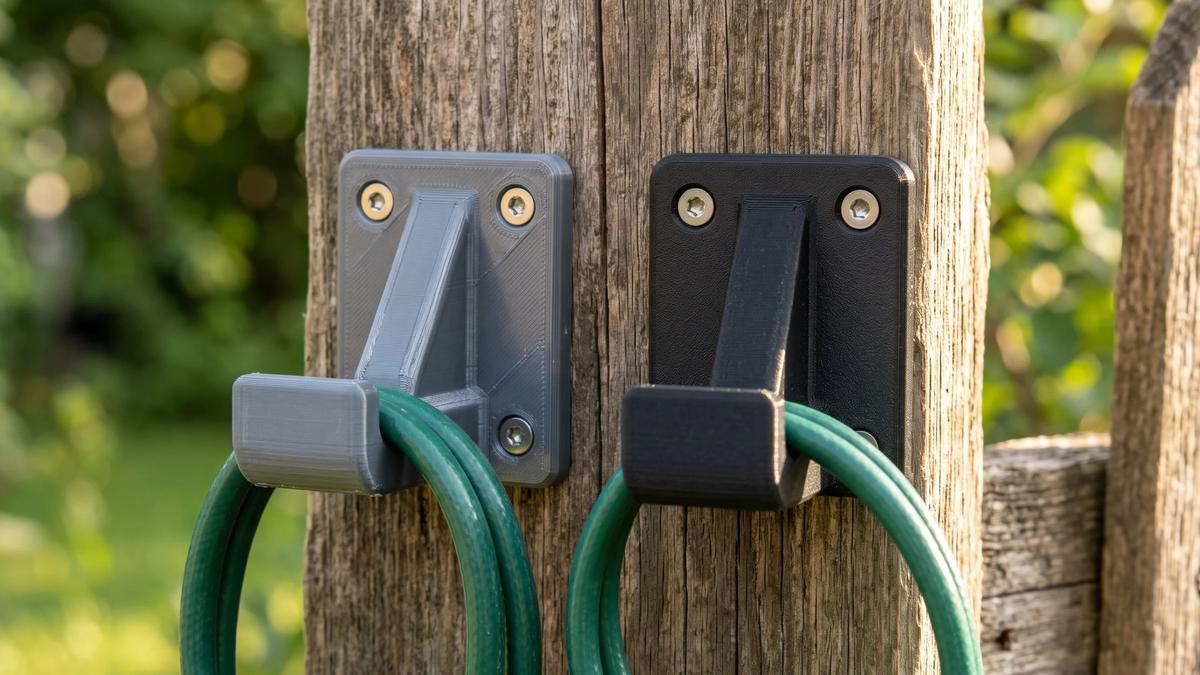

Both ASA and PETG get recommended for parts that live outside, and both handle rain far better than PLA. The difference is in three things: how they cope with years of direct sun, how much heat they take before they soften, and what your printer needs to print them. This guide compares them using the numbers the filament makers publish, and shows where ABS fits in.
The short answer
- Choose PETG for most outdoor parts that don't sit in strong sun all day or don't need to last for years: planters, garden clips, hose fittings, brackets under a roof. It prints on almost any printer with a heated bed and doesn't need an enclosure.
- Choose ASA for parts in permanent direct sun, parts that get hot, such as anything on a car's dashboard, and parts that must keep their color and strength for years. It needs a hotter bed and, for larger parts, an enclosed printer.
- ABS prints much like ASA but handles sunlight worse, so for outdoor use ASA is the better version of it.
ASA vs PETG at a glance
The figures below come from Bambu Lab's technical data sheets for its standard PETG Basic and its ASA, plus the temperature limits in Prusa's material guides. Actual properties vary by formulation, settings and geometry, so check the data sheet for your spool.
| PETG | ASA | |
|---|---|---|
| Sunlight | No published UV test data for standard PETG | Sold for UV and weather resistance |
| Heat deflection (0.45 MPa) | 69°C (156°F) | 100°C (212°F) |
| Heat deflection (1.8 MPa) | 65°C (149°F) | 92°C (198°F) |
| Prusa's stated limit | Below 80°C (176°F) | Up to 93°C (199°F) |
| Nozzle temperature | 240-270°C | 240-270°C |
| Bed temperature | 65-75°C | 80-100°C |
| Enclosure | Not needed | Needed for larger parts |
| Warping | Very little | Its main weakness |
| Fumes | Milder smell, ventilate anyway | Releases styrene - ventilate well |
| Acetone gluing and smoothing | No | Yes |
The temperatures are Bambu Lab's ranges. Prusa recommends a hotter bed: 85-90°C for PETG and 105-110°C for ASA.
Sunlight: the main difference
If you're weighing PETG vs ASA for outdoor use, sun is where they differ most. Prusa calls ASA a successor to ABS and describes it as suitable for outdoor use thanks to its UV and temperature resistance. Polymaker is the maker that publishes aging data: after two years of natural outdoor aging, its ASA changed color by less than 2.5 ΔE, a barely visible shift, and it lost minimal tensile strength in accelerated weathering. Polymaker says outdoor parts keep their integrity for at least two years.
PETG handles water well, and Prusa rates it for most exterior use, but we found no UV test results for standard PETG in Prusa's or Bambu Lab's guides and data sheets. Standard PETG isn't sold as UV-stabilized, and our guide to PETG explains why it isn't the first choice for years of intense sun. Some brands sell PETG marketed as UV-resistant, though not all of them say how they tested it.
In practice, that means:
- Shade, a covered porch, or a part you'll replace before long: PETG is a sensible choice.
- Full sun every day, for years: ASA, or a PETG sold as UV-resistant whose maker publishes test data.
- Anything where failure matters, such as a mount holding something heavy: ASA.
Heat: how hot each one can get
Heat is the other big gap. Bambu Lab's data sheets put the heat deflection temperature, the point where a standard test bar starts to bend under a light load, at 69°C (156°F) for its PETG Basic and 100°C (212°F) for its ASA. Under a heavier load the figures are 65°C (149°F) and 92°C (198°F). Prusa's material guides give looser limits: below 80°C (176°F) for PETG and up to 93°C (199°F) for ASA. They aren't measured the same way, so for a part under load, go by the heat deflection figures.
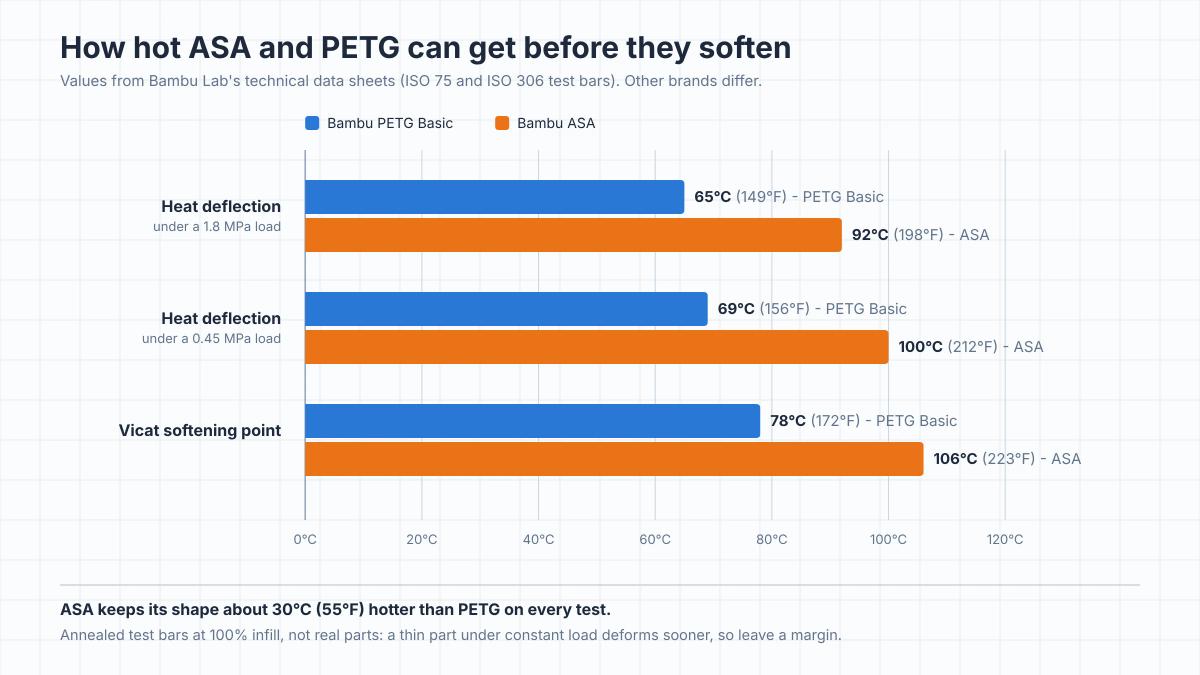
That gap of about 30°C (roughly 55°F) matters most in cars. In an Arizona State University study on summer days in Tempe, dashboards of cars parked in the sun averaged 157°F (69°C) after one hour, right at PETG's heat deflection point and well below ASA's. Placement matters too: dark parts absorb more sunlight than light ones, and a part sitting on a sunlit dash under load is far more likely to sag than an unloaded clip in the shade under it.
These numbers come from test bars printed at 100% infill and annealed before testing, not real parts. A thin part straight off the printer softens earlier, and under a constant load plastic slowly creeps and bends even below its heat deflection temperature, so leave a generous margin.
Strength and toughness
For most outdoor parts, both are strong enough, and which PETG you buy can matter more than the switch to ASA. Bambu Lab's own data sheets show it:
- Tensile strength along the layers: 48 MPa for PETG Basic, 34 MPa for the company's high-flow PETG HF and 37 MPa for ASA.
- Tensile strength between layers, in samples printed upright: 39 MPa for PETG Basic, 23 MPa for PETG HF and 31 MPa for ASA.
- Impact strength: PETG Basic scores 52.7 kJ/m² along the layers and 13.6 kJ/m² between them, against 41.0 and 4.9 kJ/m² for ASA. When the break runs along a layer line, both PETGs hold up better than ASA.
ASA's layer bond also depends on how it was printed: a part that cools too fast, without an enclosure or with the cooling fan on, splits along its layers more easily. PETG tends to bend before it breaks, which suits clips and parts that flex. ASA is lighter, though: about 1.05 g/cm³ against 1.25 g/cm³ for PETG Basic, so the same part weighs roughly 15% less. If one part has to survive both sun and load, heat and UV resistance usually decide the choice before raw strength does.
What each one takes to print
PETG
PETG prints on almost any printer with a heated bed. It barely warps, so large parts are easy, and it doesn't need an enclosure. Its quirks are elsewhere:
- It sticks hard to the bed. Prusa warns against printing PETG on a smooth PEI sheet without a release layer such as glue stick, because the bond can damage the sheet. Our bed adhesion guide covers how to protect the plate.
- It strings. Dry filament and tuned retraction help most.
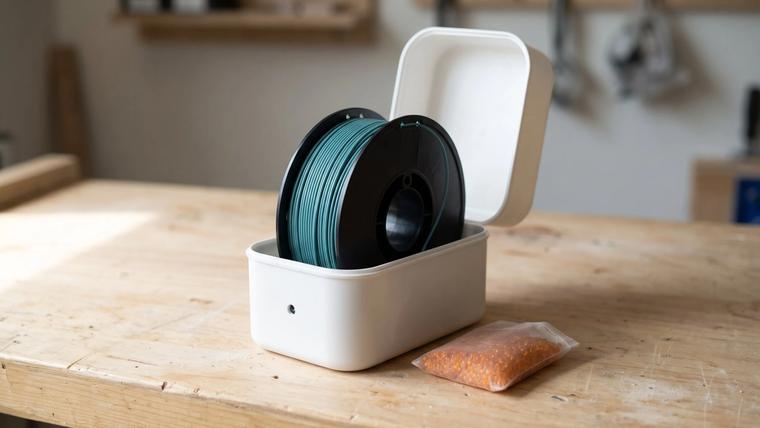
- It takes up moisture. A spool that pops or strings badly needs drying.
ASA
ASA prints a lot like ABS. It needs a hot bed, it warps as parts cool, and it gives off fumes:
- Enclosure. Polymaker says an open printer with a hot bed can handle ASA parts smaller than a fist. Larger parts need an enclosed printer, and parts bigger than about 15-20 cm (6-8 in) in any direction need an actively heated chamber. Without an enclosure, Prusa suggests a draft shield, a printed wall that keeps the part warmer.
- Warping. Prusa calls it ASA's main drawback. A brim, a hot bed and no drafts help.
- Cooling and preheating. Polymaker recommends printing ASA with the part cooling fan off, and heating the bed for about 10 minutes before the print starts so the enclosure warms up.
- Fumes. Prusa lists styrene among ASA's potentially dangerous fumes. Print it in a well-ventilated room without drafts around the printer, or in an enclosure with filtration.
- Heat inside the enclosure. Prusa also warns that printing a lot of ASA in an unventilated enclosure can deform the printer's own plastic parts, such as the fan shroud, over time.
- Bed surface. Prusa recommends a PEI sheet with glue stick for ASA.
- Dry storage. Bambu Lab's data sheet recommends drying ASA before printing and storing it below 20% humidity.
Unlike PETG, ASA can be glued and smoothed with acetone, like ABS.
Where ABS fits
ASA and ABS are close relatives. Polymaker describes ASA as almost exactly the same as ABS, with much better weather resistance as the main difference, and Prusa adds that ASA warps less and smells less. Both need an enclosure for larger parts and good ventilation.
That leaves ABS mostly for indoor parts when you already have it on hand, since ASA matches it on acetone gluing and smoothing. For anything that lives outdoors, ASA is the version to choose. Our ABS guide covers when ABS is worth the trouble, and our filament guide shows how all the common materials compare.
Frequently asked questions
Is ASA stronger than PETG?
It depends on the PETG. On Bambu Lab's data sheets, ASA tests stronger than the company's high-flow PETG HF, especially between layers, but its standard PETG Basic tests stronger than ASA in both tensile and impact strength. The gap between PETG formulations can be bigger than the gap between PETG and ASA, so for most outdoor parts sun and heat decide the choice, not strength.Is PETG good for outdoor use?
Yes, for many outdoor parts. PETG handles water and weather far better than PLA and works well in shade or for parts you don't need to last for years. Standard PETG isn't sold as UV-stabilized, though, so for parts in full sun all year, ASA or a PETG whose maker publishes UV test data is the safer choice.Do you need an enclosure to print ASA?
For larger parts, yes. Polymaker says an open printer with a hot bed can handle ASA parts smaller than a fist, while larger parts need an enclosed printer and the largest need an actively heated chamber. Without one, big ASA parts tend to warp.Is ASA safe to print indoors?
Only with good ventilation. Prusa lists styrene among ASA's potentially dangerous fumes, so print it in a well-ventilated room or in an enclosure with filtration, and don't spend hours next to the printer during long prints. Keep drafts off the print itself, since cold air makes ASA warp.Which is better for car parts?
ASA, especially for parts on the dashboard or under load. Bambu Lab's data sheets put its heat deflection temperature about 30°C (55°F) higher than standard PETG's, and in an Arizona State University study, dashboards of cars parked in the summer sun averaged 157°F (69°C) after an hour. That's enough to soften PETG, but not ASA. Unloaded PETG clips in the shade under the dash fare better than a sunlit mount holding a phone.Can you print ASA with ABS settings?
As a starting point, yes. ASA prints very much like ABS, with a hot nozzle, a hot bed and an enclosure for larger parts. Start from the temperatures on your spool's label, since each brand's ASA has its own recommended range.Does PETG turn brittle in the sun?
It can, over years of exposure, often along with faded color. Filament makers don't publish UV aging data for standard PETG, which is why ASA is the safer pick for parts that sit in full sun for years. Keeping a PETG part in shade reduces the risk.
About the author
Written by
Ethan MillerI’m a 3D printing specialist with a background in mechanical design and hands-on experience with FDM 3D printing. I focus on filament selection, slicer settings, print optimization, and troubleshooting common printing issues. I enjoy testing different materials and printing techniques and sharing practical guides that help makers get more consistent and reliable results from their printers.