FDM vs resin for miniatures: which printer should you actually buy
· 6 min read
Every miniature hobbyist hits this fork in the road: the crisp detail of resin prints is tempting, but FDM printers promise a simpler life. Both camps are loud, and both are right - about different things. This guide skips the tribal arguments and compares what actually matters: detail, real cost (not sticker price), the weekend-to-weekend workflow, safety, and durability on the table. By the end, you'll know which side of the fork fits your situation - and why many hobbyists eventually stop choosing.
Resin if painted character miniatures are the point of the hobby for you - faces, armor texture, display pieces - and you have a ventilated space plus tolerance for a chemical workflow.
FDM if you want the simplest path to the table, print lots of terrain alongside figures, or share living space where resin's smell and safety requirements are a dealbreaker.
Both, eventually, if the hobby sticks - that's where most serious tabletop printers land. Now the details behind that answer.
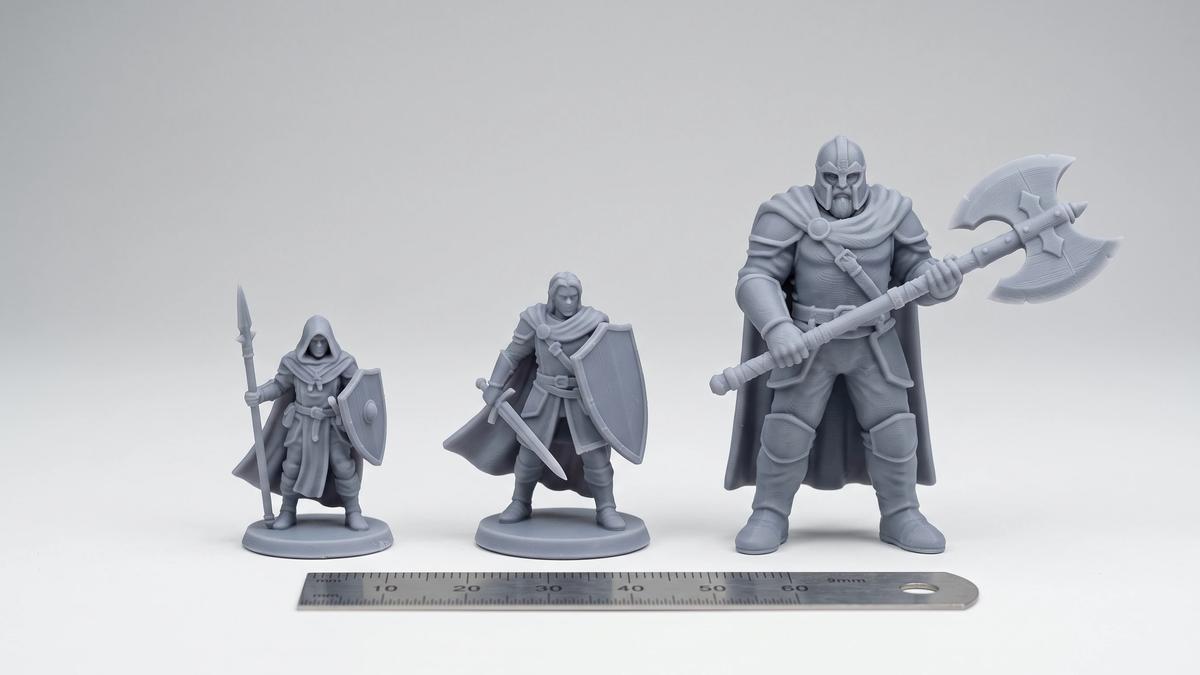
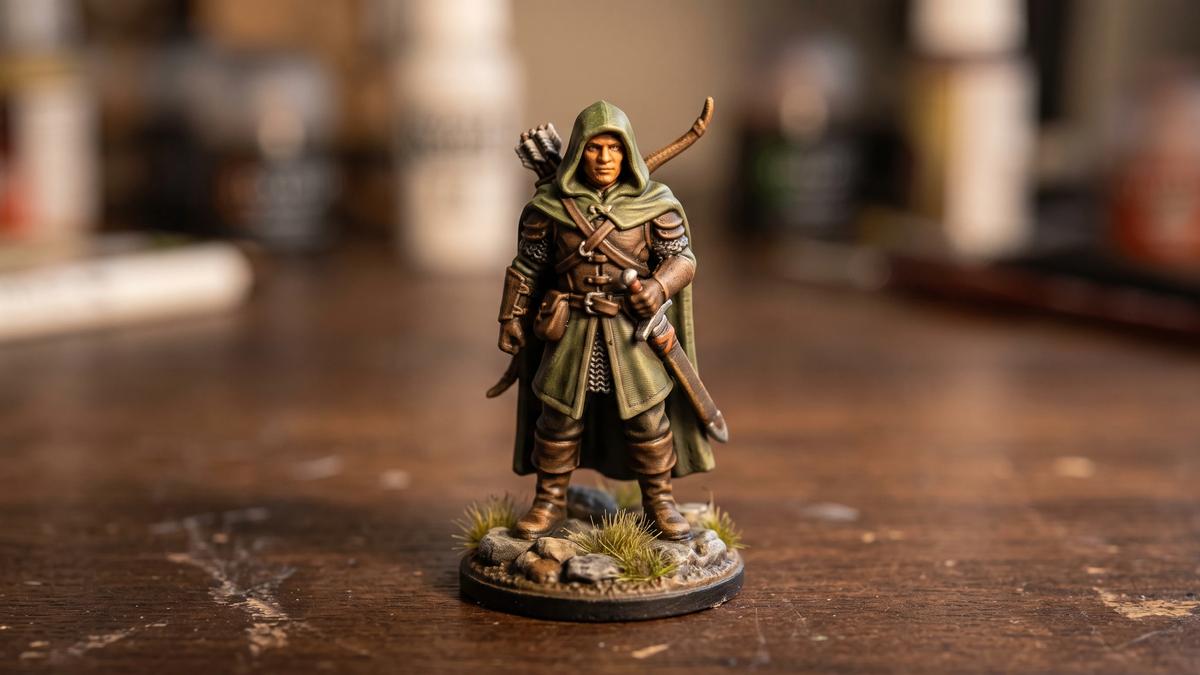
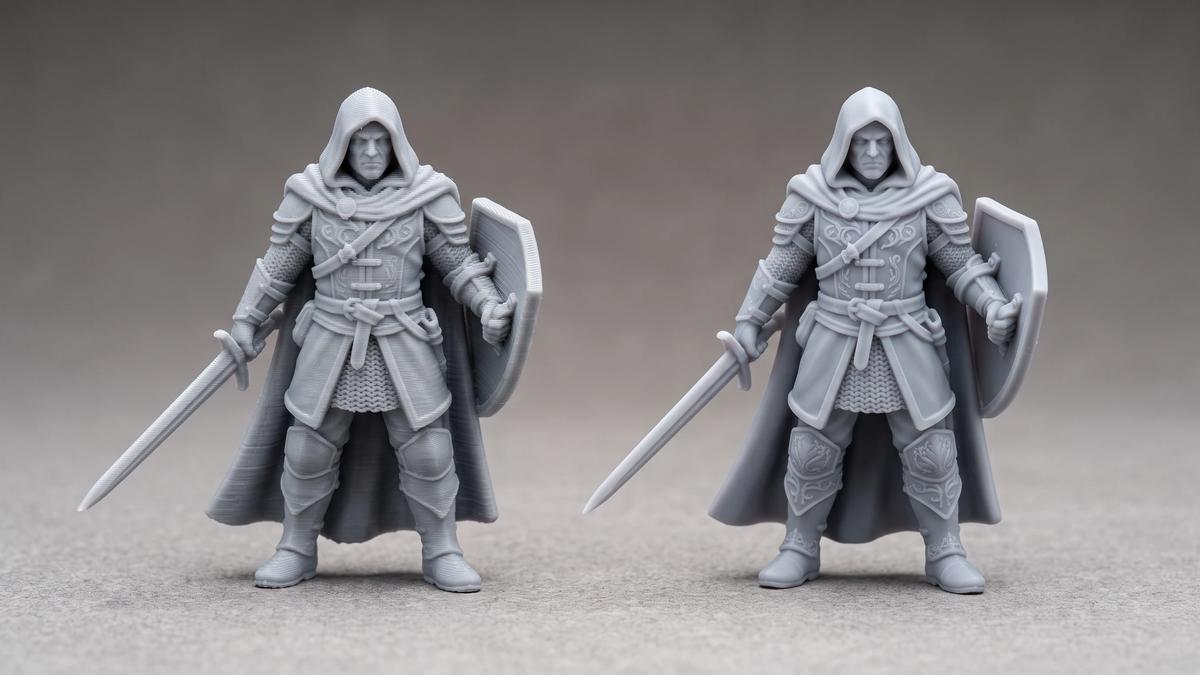
No point pretending otherwise: resin printing produces visibly finer miniatures. The technology cures entire layers of liquid resin at resolutions FDM physics can't match, which is why it captures facial expressions, armor filigree, and tiny text without visible layering. It's the standard for display-grade work - even professional miniature studios print their masters on resin machines.
But the margin matters less than the marketing suggests. The comparison most people imagine - perfect resin mini vs crude stepped FDM blob - is based on FDM printed with default settings. Printed properly (fine 0.08–0.12mm layers, 0.2mm nozzle, tilted with tree supports), an FDM miniature after priming and paint holds up fine at tabletop distance. [The full FDM miniature technique → /blog/how-to-print-miniatures-at-home-fdm/]
The honest framing: resin is required for display quality; FDM is sufficient for table quality. Decide which one you're actually printing for.
Entry printers in both camps cost roughly the same - capable machines start around $200–300 either way. The difference is everything around the machine.
FDM's running costs are boring, in the best way. Filament runs $15–25 per kilogram, which works out to pennies per miniature - around $0.02 of plastic for a typical figure. Beyond filament, there's little to buy.
Resin's running costs stack up. The resin itself is $25–50 per liter (a typical mini uses about $0.05 worth - still cheap per figure). But then the supporting cast arrives: isopropyl alcohol for washing prints, used continuously; nitrile gloves by the box; FEP film for the resin vat, replaced every 1–3 months at $10–15; and eventually the LCD screen itself, a wear item rated for roughly 2,000–3,000 print hours. Realistic first-year totals at the entry tier come out to roughly $440 for FDM versus $750 for resin.
Neither number should scare you off - but budget for the ecosystem, not the printer.
This is the difference people underestimate most.
FDM: print finishes → pop the model off the plate → clip the supports → done. The part is safe to handle bare-handed the moment it comes off. Failed prints are plastic scraps for the bin.
Resin: print finishes → gloves on → drain and remove the print → wash it in isopropyl alcohol → cure it under UV light → clean the vat → filter the leftover resin → dispose of contaminated towels and IPA properly. A wash-and-cure station automates part of it, but every print session involves chemistry. Skipping steps isn't an option: uncured resin on a model stays tacky and unsafe to handle.
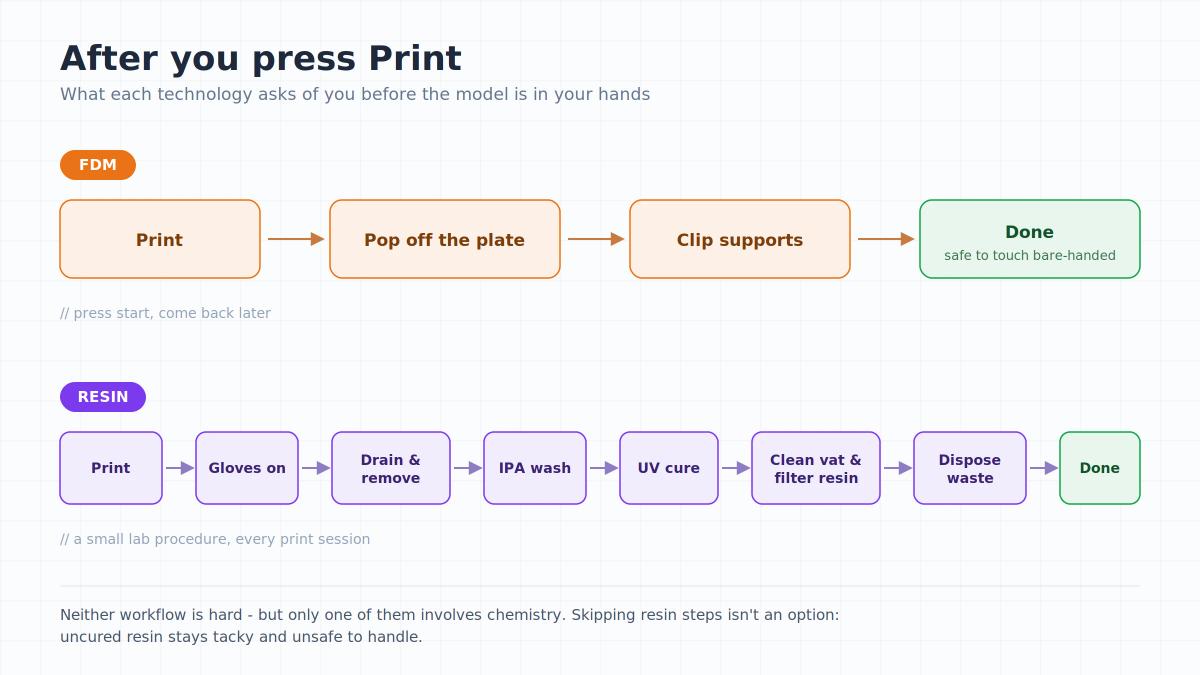
Neither workflow is hard. But one is "press start, come back later" and the other is a small lab procedure, every single time. Be honest about which one you'll still enjoy on print #200.
FDM with PLA is about as benign as a hobby machine gets - fine in any ventilated room, no protective equipment, prints safe to touch immediately.
Resin demands respect. Uncured liquid resin is a skin irritant and sensitizer - nitrile gloves and safety glasses are mandatory, and ventilation to the outside is strongly recommended, not optional. The IPA used for washing is itself a hazardous solvent that needs proper disposal. None of this is unmanageable - thousands of hobbyists run resin printers safely in garages and dedicated corners - but it rules out certain spaces. A resin printer on the living-room bookshelf, around kids or pets, is a genuinely bad idea.
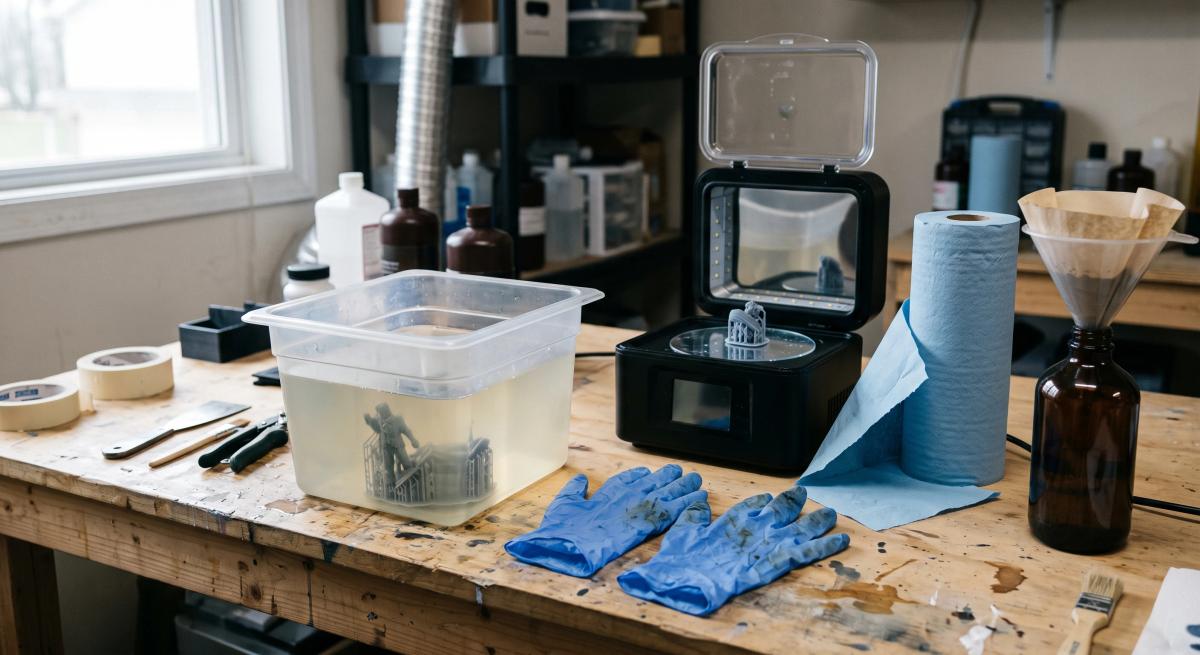
If your printer must live in shared family space, this section alone may make the decision for you.
The two technologies are fast at different things.
Resin printers cure a whole layer at once, so print time depends on the model's height, not how many models are on the plate. One 32mm figure or fifteen of them - nearly the same print time. For batch-producing a squad of identical troops, resin is remarkably efficient (until the washing and curing of fifteen figures begins).
FDM prints each model's perimeter individually, so time scales with quantity - but there's no post-print chemistry, so a finished FDM plate reaches the table faster. For large pieces like terrain, FDM's bigger build volumes (200–300mm is typical, versus 150–200mm for consumer resin machines) and cheap filament make it the obvious choice.
Miniatures get handled, dropped, and stuffed into transport cases. Standard resin prints are brittle - thin swords and spear tips snap under stress that FDM plastic shrugs off. Tougher resin formulations narrow the gap at extra cost, but for pieces that live hard lives - terrain, tokens, anything players grab constantly - FDM's toughness is a real advantage, not a consolation prize.
Watch what experienced tabletop printers actually do, and a pattern emerges: they own both. Resin handles character miniatures, heroes, and display pieces where detail is king. FDM handles terrain, buildings, dice towers, bases, and rank-and-file forces where volume, durability, and cost per part win. Many started with one machine, learned its limits, and added the other within a year or two.
If you can only start with one: pick based on the majority of what you'll print. Mostly characters and painted figures → resin (if your space allows it). A mix of figures, terrain, and functional pieces → FDM, printed with proper miniature technique.
Either way, the files come first - both technologies print from the same STL and 3MF models, so your library transfers if you switch or expand. [Browse miniatures → /miniatures/]
| FDM | Resin | |
|---|---|---|
| Detail | Tabletop quality (with tuned settings) | Display quality |
| Entry printer | ~$200–300 | ~$200–300 |
| First-year realistic cost | ~$440 | ~$750 |
| Post-processing | Clip supports, done | Wash, cure, chemical cleanup |
| Safety | PLA: minimal | Gloves, glasses, ventilation required |
| Batch printing | Time scales with quantity | Whole plate ≈ one model's time |
| Durability | Tough, handles table life | Brittle unless using tough resins |
| Best at | Terrain, bulk, functional pieces | Characters, faces, fine detail |
Written by
Ryan CarterI’m a 3D printing and miniature painting specialist with a background in digital modeling and tabletop gaming. I focus on 3D-printed miniatures, resin and FDM printing, model preparation, supports, priming, painting, and finishing techniques. I enjoy experimenting with different workflows and helping makers turn digital models into detailed, tabletop-ready miniatures.